10 years of app development

i'm nearing the 10 year mark of when i started my career in app development.

maybe you've used some apps i've worked on before! or maybe not. i've had the privilege to work on almost every type of app possible:
- apps for hardware (pool sensors, exercise equipment)
- apps as medical devices (shoe sensors for gait training)
- apps for the travel industry (cash and points flight finders)
- greenfield apps, brownfield apps, archaic corporate apps, apps in public
i feel its cliche to say "i've learned so much along the way" because, like most things in tech, the industry standards and patterns have changed so much. every single app is completely different and only a small set of learnings i've picked up actually end up carrying through to other apps.
what i really have learned is about app users. the way people utilize and behave regarding apps is completely different than their interactions with websites and web apps, and that is the same across the board.
how to get people to delete your app immediately
before i was in tech, i actually went to film school 🤡 and the only thing i learned there that actually applied to my career now is something my professor of a screenwriting class said:
you must capture your audience within the first 5 minutes, or else they won't care.
i think anyone who owns a phone has participated in the ritual of downloading an app, opening it, and then immediately deleting it. usually its for one of these reasons:
- paywall blocking first use. if i don't even know what your app looks like or can't even use it for 5 minutes before you shove a paywall in my face, i'm deleting it.
- long arduous onboarding with no skip button. again, i haven't even seen what your app can do for me, i don't want it to interview me. and these onboardings always end in a paywall. next.
- forcing me to immediately make an account. brother again, i haven't seen your app or know if it does what i want it to do. i'm not giving you all this information and another password to forget. bye.
- app looks like shit or slop. if your app looks like it was designed by a backend engineer (sorry, love u), is using Google's material design when I'm on an iPhone, or is very obviously Claude slop, its getting yeeted.
users want to know if your app can accomplish what they are hoping it does. if it does, they more than likely will pay something for that* (see next section), and/or they will use it.
imagine i want to browse a physical store to see if it has what i want and the store owner tells me i have to pay them to go in there. i'm going to leave. costco is the only exception.
how to get people to pay for your app
everyone hates subscriptions and its dumb to force them on your user without merit. someday i'll write about the subscription economy. anyway, show people your app completes the task they want.
based on the type of app you offer, consider the appropriate revenue model:
use case | model | example |
|---|---|---|
a contextual service | pay-per-use or short subscription (weekly/monthly) | travel applications or games (users schedule or preferences change over time) |
a tool or utility | one-time payment or pay-per-upgrade | camera utilities/editors (things that update based on hardware that are limited by hardware) |
a partner app to another product | free. like, non-negotiably free. | washing machines, printers, fridges, air conditions, etc. |
a consistent or daily use service | subscription model | financial/health trackers with actionable insights; something that would meaningfully impact someone's daily life. |
mixing and matching these models usually works best if you're willing to have multiple user sets.
in-app purchases for random things in an app while the rest is free to use, i've never seen that become an issue, unless your in-app purchase for a specific thing is then automatically a yearly subscription. see above.
many folks get twitchy and annoyed with me when i suggest that they don't revoke their user's right to own the thing they purchased. "but maintenance costs!" your job is to prove to your users that your revenue model is honest of the need and and it should reflect in your offering.
if a user is going to use your app on a consistent basis and derive meaning from it on every open, they'll probably subscribe to it. that's what subscriptions are actually for.
how to get users to like you
not gonna happen, next question.
actually no but seriously, app users are haters. idk what's wrong with you all (i'm one of them).
app stores are digital grocery stores
so many apps exist. there is probably one that encompasses Your Next Great Idea already out there. you don't know it exists though because of marketing.
app stores are the digital grocery store equivalent, where a loose concept of the slotting allowance like that of a traditional grocery-retail model is at play. developers are not only competing for users, but they also have opportunities to pay for access, promotion, and position in the stores. its not as direct as "buying your way in" because that's illegal but you must have marketing skills to outbid all of the other apps.

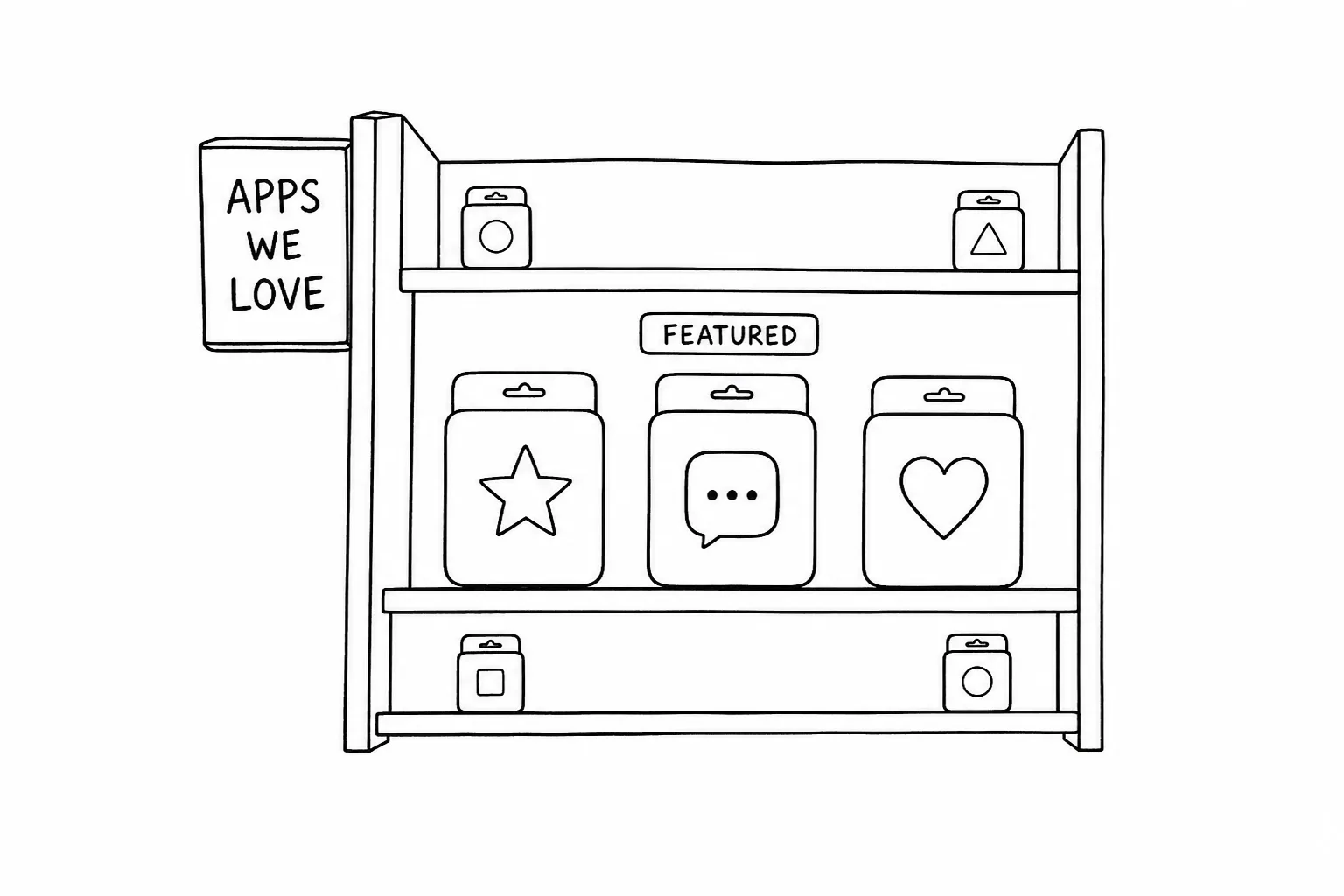
the 'shelving' of the app stores are the category rankings, editorial features, and ad placement. "apps we love" are the endcap collections. the products at eye level are the companies with enough money, recognition, or existing users to convince the store they belong there. everything else is at the very bottom or top of the shelf, hoping someone can reach or see it.
all this means is that making a good app and a successful app are two completely different jobs. developers love to believe quality will win. if the app is useful enough, fast enough, and pretty enough, people will find it. the app store only cares about what it can evaluate: downloads, conversion, retention, ratings, revenue, and whether it's already been searched for.
so just ship it!
i hate this saying when it comes to apps. getting into the grocery store is the easy part, getting into someone's shopping cart is not. your app could be incredible, but if on its face it looks:
- confusing (doing or saying too much)
- generic (i.e. slop)
- suspicious (i.e. a dupe of something that exists, or slop again)
- expensive (i.e. it costs $12 to walk out of the store with it before even trying it)
ultimately you need this process to work end-to-end for your app to be continuously successful:
- getting into the store: marketing
- getting someone to pick you: presentation
- getting someone to purchase you: proving you solve their problem at a price that makes sense
- getting evangelized at the potluck: delivering on your solution
developers often treat each of these as separate problems: add more onboarding so users "get it", add a paywall sooner so people are encouraged to pay, add a subscription because it converts better, buy more ads because nobody is downloading it.
none of that fixes the problem. i'm not buying cheese nips when cheez-its exist.
in conclusion
app users are remarkably consistent. they want to accomplish something, and they want to know if your app can do it and not get tricked along the way. let them browse your app and make your value obvious. make the price reasonable. give them a reason to not immediately delete it. after 10 years that's all i can tell you really as a universal truth.
and yeah you have to pay for marketing.